Showing posts with label Fair Trade products. Show all posts

Wednesday, March 16, 2016

New Showroom Open this Weekend!

Come check out our new showroom this Friday and Saturday, March 18-19!

"We are so excited to be opening to the public," said owner Cael Chappell. "Our products used to have a big presence at Peacecraft, so ever since that closed we have been looking to promote our handmade, Fair Trade crafts in New Mexico."
New Showroom at 4603 McLeod NE, Albuquerque, 87109

Located at 4603 McLeod NE, at the corner of Jefferson and McLeod in Albuquerque, the showroom is open on Fridays 10 am - 4 pm, and by appointment.

"We will be open this Saturday to give people a chance to get a basket in time for Easter," said Chappell. "Our grass baskets from Ghana are perfect for that!"

Ghana Bolga Mini Market Baskets
Grass Mini Market Baskets from Ghana
Baskets of Africa has been a member of the Fair Trade Federation for over 10 years.

"We are very proud to be members of the Fair Trade Federation," said Chappell. "Everything we do revolves around our mission to help the weavers and artists in Africa."

The showroom features Shona stone sculpture, handmade textiles such as Kente cloth and Kuba cloth, African masks, and baskets from over a dozen countries.

All of these products are also available online: www.BasketsOfAfrica.com, and www.AfricanAllure.com. To make an appointment, call (505) 323-2315.

Kente Cloth

Shoowa Mat

Shona Sculpture — Loving Family

Sisal Bowl

Cloth Handle Shopping Tote


Tuesday, February 2, 2016

Every Box We Ship Supports Forest Restoration

UPS Carbon Neutral Shipment Logo
At Baskets of Africa, the way we do business is very important to us. From the start, our focus has been to give back as much as possible to the weavers who create our amazing products.

But as the business has grown, so have the opportunities to do business in a manner about which we can be proud. One such opportunity is the Carbon Neutral Shipment program that UPS offers. Baskets of Africa is pleased to have been supporting this program for eight years now.

We pay a bit extra on every box we ship in order to support the restoration to dense forests in a 24,000 acre tract of land in Northern California. The Nature Conservancy manages the land and this UPS program helps to fund it.


"Fighting climate change, restoring critical wildlife habitat, providing jobs to the local community— the Garcia River Forest project represents a powerful combination of stewardship efforts that will change the way people think about forest conservation.

The 23,780-acre forest has become a model site for demonstrating the important role forests play in addressing climate change. Its ecosystems safeguard habitat for rare and threatened species. And careful, selective logging of its redwood and Douglas fir timber contributes to the local economy of Mendocino County." - The Nature Conservancy


Wednesday, January 27, 2016

Three Zulu Weavers, Three Unique Weaving Styles

At Baskets of Africa, we have the honor of having worked with some of the same artists for years and years, especially the creators of Zulu Ukhamba baskets. Over time, some of the weavers have developed very distinct — and beautiful — artistic styles, especially Jabusilwe Mhlongo, Thulisile Nsele, and Nomkhosi Nkosi, who always have at least one basket ready for us to pick up.

Jabusiliwe's baskets are striking and unusual because of her use of pink. Most of our weavers still make their dyes by hand using plants native to the grassy mountains where the weavers live. Pink is extremely difficult to make and, therefore, very rare in Zulu baskets. Jabusiliwe uses the pink sparingly, usually on a very light colored basket with other muted colors worked into the design.

Weaver from Zululand holds a Ukhamba basket she made.
Zulu weaver Jabusiliwe Mhlongo and her Ukhamba basket.

Like Jabusiliwe, Thulisile uses unusual colors like warm red, burgundy, and purple in her baskets, but she often creates a modern, organic, zigzag pattern for her tall, slender Ukhamba baskets. Her body of work reflects a mastery of her craft and an eye for modern design. Having traveled so far from the simple farm home where they are created, her baskets successfully accent a variety of urban interior designs.

Zulu weaver at her home holds a Ukhamba basket she created.
Thulisile Nsele uses bold designs for her Ukhambas.

Nomkhosi uses traditional colors and traditional patterns for her baskets. The diamonds and stair step patterns have specific meanings when this type of basket is given as a wedding gift from the bride's family to the groom's. Nomkhosi's baskets are extraordinary because she often uses these traditional patterns in an asymmetrical presentation, so the patterns do not repeat. The colors she uses for her Ilala palm are warm and inviting, and her weaving is so expert that the surface of her baskets is tight and smooth.

Ukhamba weaver and her basket with traditional diamond and stair step designs.
Nomkhosi uses traditional patterns in her designs.

These three weavers not only represent a mastery of their craft, but also serve as as ambassadors of basket weaving as traditional art continues to find its place in modern décor. View our collection of Ukhambas at: Baskets of Africa — Zulu Ilala Palm Baskets.


Thursday, October 8, 2015

What is So Unusual About Zulu Wire Baskets?

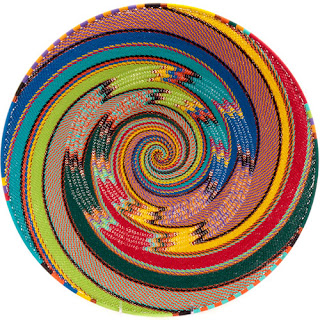
For many years now Baskets of Africa has had the pleasure of working with a group of weavers in Zululand who create colorful baskets woven from a rather unusual material: plastic-coated wire.

Originally created from telephone wire, these baskets are also unusual because of the process in which they are woven.

Traditionally, baskets are created by starting at the bottom and weaving up and out. Zulu wire baskets, however, are created by wrapping the wire around the rim first, then working down and into the center, tightly weaving over a form.

 Woven wire bowl

The bowl pictured above was made by wrangling at least 34 strands of wire into a beautiful swirling rainbow of color — no easy feat. And the platter pictured below was started with 135 pieces of wire.


 Zulu woven wire platter

As the artist worked toward the center, the design got smaller and smaller and pieces of wire are carefully trimmed. When the weaver completed the platter, the few remaining pieces of wire were trimmed and smoothed. The result is a smooth surface and a vibrant design.

Perhaps the most challenging shape to create is the lidded pot.

 Colorful woven wire lidded pot


These are also woven from top to bottom, but they are woven over a form that has to be broken when the weaving is done.

Zulu wire baskets represent some of the most modern and vibrant weaving available today. Explore the variety of colors and shapes this weaving group creates in our Zulu Wire collection: http://www.basketsfromafrica.com/items/zulu-wire-baskets/list.htm